
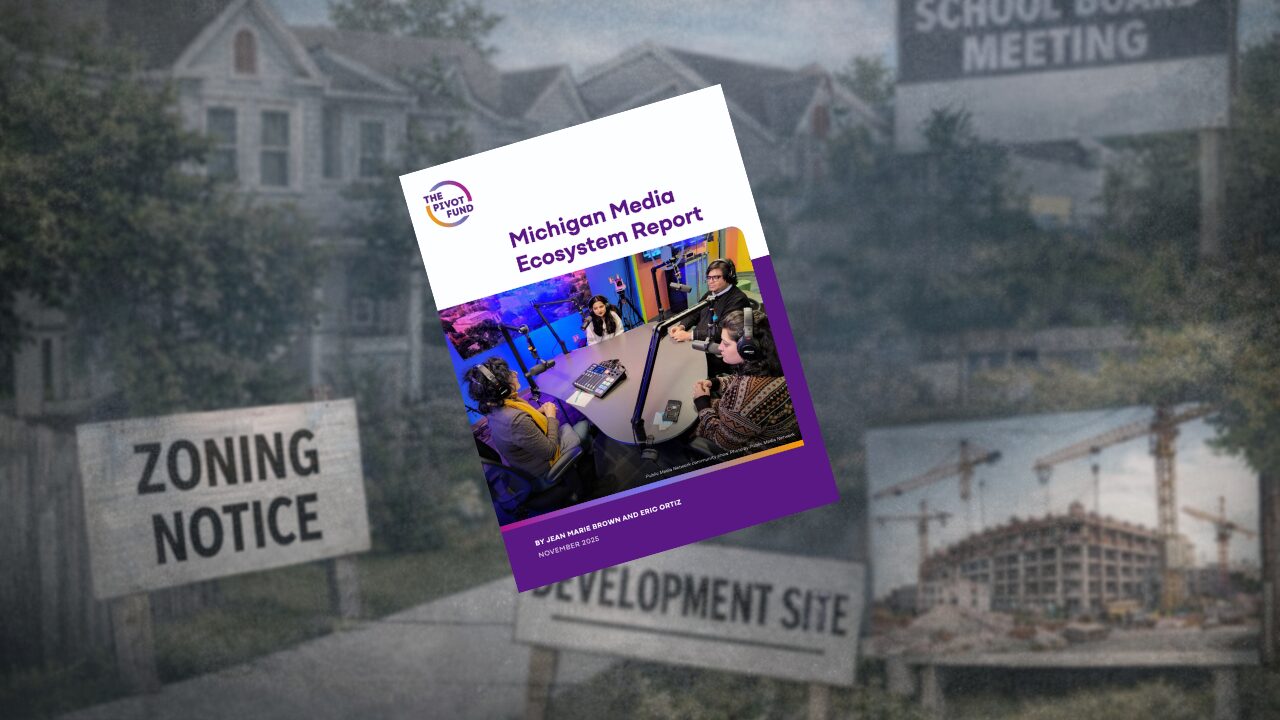
Something is broken in how communities get the information they need to function, and a new statewide report puts data behind what many of us already know from experience.
The Michigan Media Ecosystem Report, published in November 2025 by The Pivot Fund, spent months talking with Michigan residents about how they find, trust, and use local news and information. The findings are striking: people are consuming news constantly, yet most don’t feel well-informed about what’s happening in their own communities. They’re cobbling together information from Facebook groups, word of mouth, Google searches, and direct calls to city hall, not because they don’t care, but because the systems that were supposed to keep them informed have contracted, consolidated, or disappeared entirely.
This isn’t just a media industry problem. It’s a civic problem.
From Local News to Civic Media
For decades, the dominant model for local information was a commercial one. Newspapers and broadcasters supported by advertising operated as businesses first and civic institutions second. That model has largely collapsed, and what’s filled the void is uneven at best: national outlets that don’t cover your school board, social media platforms optimized for engagement rather than accuracy, and a patchwork of independent outlets struggling to survive without sustainable funding.
What the Pivot Fund report makes clear and what organizations like News Futures are working to articulate at a national level is that the solution isn’t simply to save journalism as an industry. It’s to reimagine news and information as a public utility. As News Futures puts it in its founding principles, the goal is to establish news as “an essential public utility” and “a community asset that thrives based on the unique needs, assets, and culture of the community it serves.”
That reframing matters. When we talk about civic media rather than local news, we shift the conversation from market failure to community need, from what’s profitable to what’s essential. Civic media is oriented around service, participation, and accountability to the public rather than to shareholders or advertisers. It covers what communities need to know to govern themselves, engage with each other, and make decisions about their collective future.
What the Michigan Report Shows Us
The Pivot Fund’s findings illustrate both the depth of the problem and the resilience of communities trying to solve it on their own. Across listening sessions in Detroit, Flint, Kalamazoo, rural communities, and tribal lands, a consistent picture emerged: residents want local information that is accurate, relevant, and reflective of their actual lives, not just crime and crisis, but zoning decisions, school board votes, community resources, and positive developments in their neighborhoods.
They’re not finding it through traditional channels. Instead, they’re turning to neighborhood associations, community organizations, Facebook groups, and trusted individuals to fill the gap. As the report notes, this patchwork approach reflects both the ingenuity and the frustration of communities left without reliable civic information.
The report also highlights a generation of media entrepreneurs, many of them from the communities they serve, who have stepped in to fill coverage gaps that legacy outlets left behind. These outlets are doing essential civic work, but they’re doing it under significant financial strain, without the infrastructure or sustained funding that would allow them to grow and serve their communities more fully.
PMN as a Civic Media Model
Public Media Network is featured in the report as an example of an organization that has taken the civic media framework seriously, not as a slogan, but as a practice.
A few years ago, PMN made a deliberate choice to listen before acting. The team spent months in conversation with residents, particularly in communities that had been underserved and underrepresented in local media, asking what they wanted to see, what was missing, and what would actually be useful to them. That listening shaped programming decisions, training investments, and outreach strategies.
The result is an organization that looks less like a traditional broadcaster and more like a civic institution, one that covers local government, trains community producers, amplifies underrepresented voices, and provides the tools for community members to tell their own stories. That’s civic media in practice: service-oriented, participatory, and accountable to the community it serves.
The Policy Case
Here’s what the Pivot Fund report, the News Futures framework, and PMN’s own experience all point toward: civic media requires sustained public investment to survive and grow.
The market has demonstrated it cannot solve this problem on its own. The communities most in need of reliable civic information are often the least able to support it through subscriptions or advertising. And the outlets doing the most important work, hyperlocal, community-centered, trusted by the people they serve, are frequently the least resourced.
The Pivot Fund’s recommendations to funders point in the right direction: multi-year operational support, investment in underserved communities, funding for digital access and media literacy. But philanthropy alone is not enough. The civic media sector needs policy frameworks that treat community information infrastructure the way we treat other essential public goods with public funding, public accountability, and a long-term commitment to equitable access.
As policymakers at the local, state, and federal level begin to grapple with the collapse of local news, reports like this one serve as evidence. Organizations like PMN, already doing the work, already trusted by their communities, already demonstrating measurable civic impact, are exactly the kind of institutions that public investment should be designed to support.
The question isn’t whether we can afford to fund civic media. It’s whether we can afford not to.
Read the Michigan Media Ecosystem Report. Learn more about the News Futures framework at newsfutures.org.


