Most conversations about the future of local news start in the same place: decline. Shrinking newsrooms, disappearing coverage, communities left without reliable information about the things that shape their daily lives. It’s a real problem, and it deserves serious attention.
But recently I had a conversation that started somewhere different.
A few weeks ago I attended a News Futures Convention, a gathering of people who are serious about building something better for their communities, not just stabilizing what’s left of the old model. And the mix of people in the room said everything about why this effort feels different.
Journalists, yes. But also librarians. Policy experts. Community organizers. Funders. Low-power radio operators. Academics. People from the democracy-building and civic engagement fields. What brought them together wasn’t a shared professional identity, or where they work. They all shared a belief that a healthy information future requires more than a healthier news industry. It requires a whole community of stewards.
That conviction is at the heart of the News Futures framework. Their principles are worth sitting with: that news should function as a community asset, shaped by the needs and culture of the people it serves. That storytelling is an act of care. That collaboration across sectors isn’t optional, it’s the only way to actually serve everyone. And that the people who have been most excluded from and harmed by traditional media must have a real role in shaping what comes next.
What struck me most was the energy in the room around a broader vision of what a healthy information ecosystem actually looks like. It isn’t just professional newsrooms doing better work, as important as that is. It’s the full web of how communities share what matters. Formal and informal. Trained journalists and engaged neighbors. Civic institutions and everyday people who share information because they care about where they live.
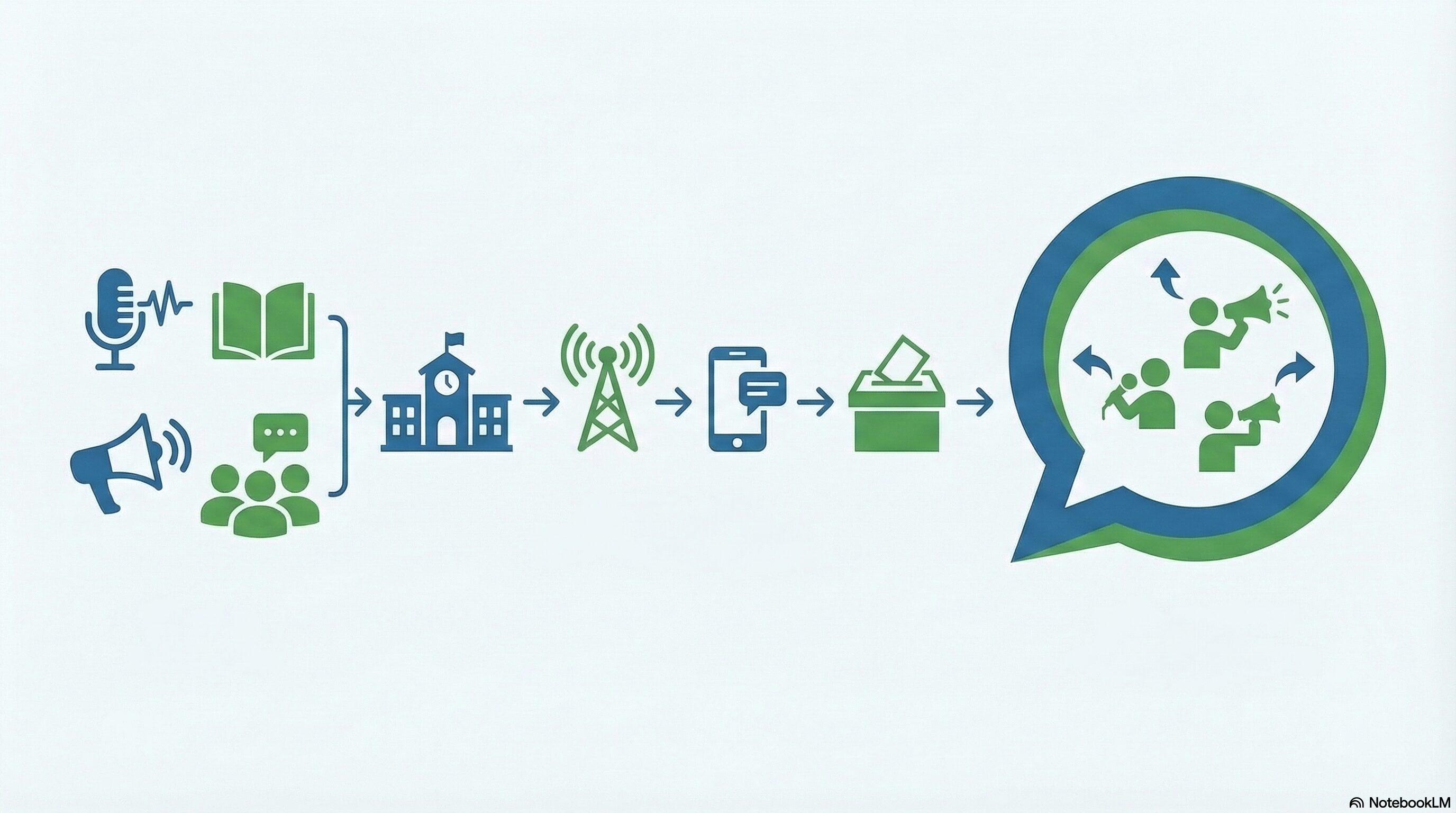
Think about how information actually moves through a community. A school board decision gets covered at a meeting, shared by a local outlet, discussed by a parent at pickup, passed along in a neighborhood group chat, and eventually shapes whether someone shows up to vote on a millage. That chain is only as strong as its weakest link. When any part of it breaks down, when meetings go uncovered, when outlets disappear, when people don’t have access to reliable information, communities lose something they can’t easily get back.
Building something better means strengthening that whole chain. It means investing in the formal infrastructure like community media, local journalism, public access, and the informal networks that communities already rely on. It means bringing more people to the table, not fewer.
That’s the work. And it’s bigger than any one organization or any one field.
Here in Kalamazoo, PMN has been part of that infrastructure for decades: covering government meetings, amplifying diverse community voices, and providing open platforms where residents, organizations, and institutions can tell their own stories. Spaces like News Futures remind us that this work is part of a much larger effort. The goal isn’t preservation. It is a community where everyone has access to the information they need to participate, to connect, and to thrive.

